
If you live in Central Virginia, you live on a slope. The Piedmont region between the Blue Ridge Mountains and the coastal plain is a landscape of rolling hills, creek valleys, and grade changes that make flat yards the exception rather than the rule. Retaining walls turn those slopes from liabilities into assets -- creating level spaces for patios, gardens, and lawns where gravity would otherwise win.
Natural stone retaining walls have been holding Virginia hillsides for centuries. The dry-stacked fieldstone walls that line country roads in Albemarle County were built by hand in the 1800s and are still standing. There is a reason for that: natural stone is dense, weather-resistant, and -- when properly engineered -- structurally superior to any manufactured alternative. It also looks like it belongs in the Virginia landscape, because it does.
At Snow Knows, our hardscaping team has built retaining walls on properties across Charlottesville, Keswick, Ivy, Crozet, and throughout Albemarle County for over a century. This guide covers the design decisions, stone choices, and engineering considerations that make the difference between a retaining wall that lasts a generation and one that fails within a decade.
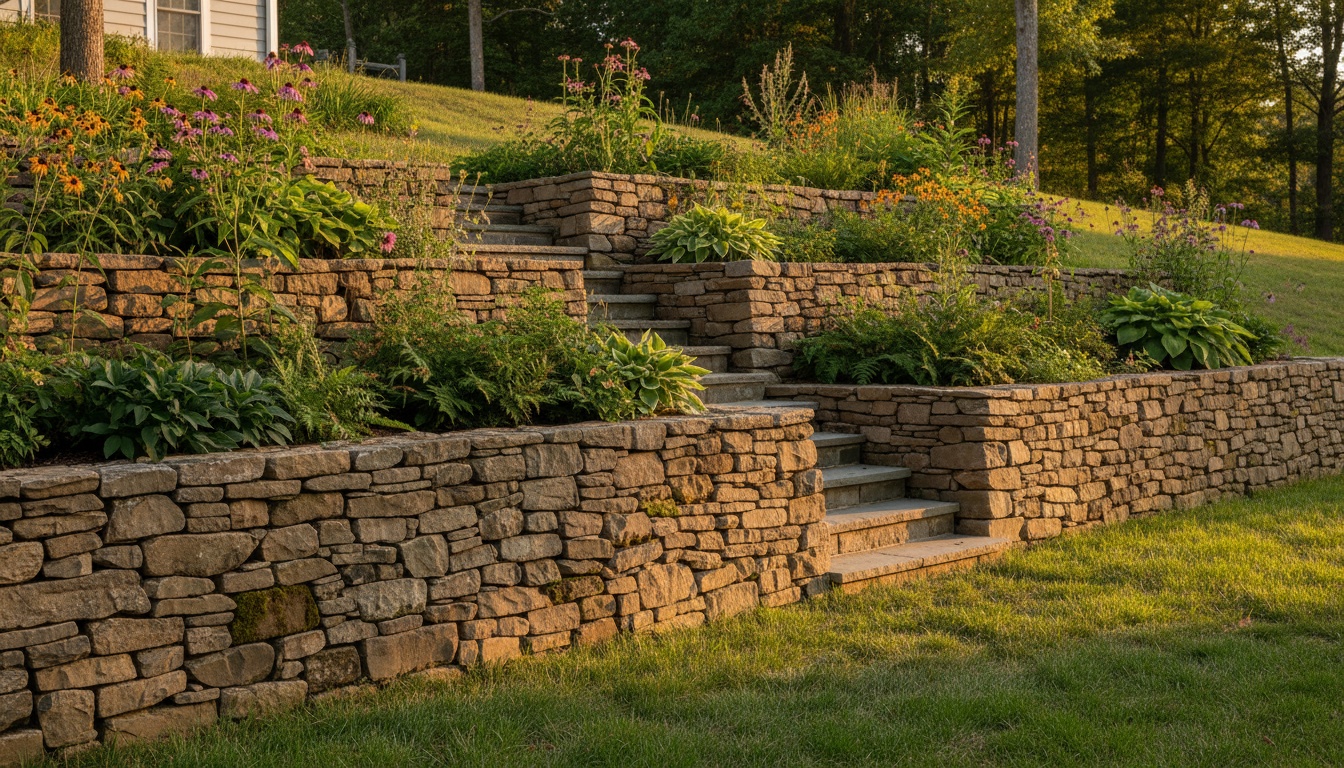
When You Need a Retaining Wall
Not every slope requires a retaining wall. A gentle grade of 15% or less (roughly a 1.5-foot rise over 10 feet of run) can usually be managed with grading and groundcover plantings. But once slopes exceed that threshold, or when you need to create a level area on a hillside, a retaining wall becomes the right solution.
Common situations that call for retaining walls in Central Virginia:
- Creating a level patio on a sloped lot: Most Albemarle County properties have at least some slope behind the house. A retaining wall at the downhill edge of a patio creates the level surface you need without moving massive amounts of earth.
- Preventing soil erosion: Virginia's red clay soils are prone to erosion, especially on slopes where stormwater runs off before it can infiltrate. A retaining wall holds the soil in place and redirects water through engineered drainage.
- Terracing a steep hillside: A single tall wall is not always the best answer. A series of shorter terraced walls steps down the slope, creating multiple level planting beds and a more natural appearance.
- Protecting a foundation: When the grade slopes toward your house, a retaining wall uphill of the foundation redirects soil pressure and water flow away from the structure.
- Adding usable yard space: Retaining walls can reclaim sloped areas that are currently unusable -- turning a steep side yard into a garden, a play area, or an extension of the lawn.
Stone Types for Retaining Walls
The stone you choose affects the wall's appearance, construction method, cost, and longevity. Here are the options that perform best in Central Virginia.
Virginia Fieldstone
Locally quarried or gathered fieldstone is the most traditional retaining wall material in the Virginia Piedmont. The warm gray and tan tones match the native rock outcroppings visible throughout Albemarle County. Fieldstone walls are typically dry-stacked (no mortar), with each stone carefully fitted and the wall tilted slightly back into the slope (called "batter") for structural stability.
- Appearance: Rustic, organic, deeply rooted in the Virginia landscape
- Construction: Dry-stacked or lightly mortared. Requires skilled masons who understand stone fitting.
- Cost: $35-$60 per square foot of wall face installed
- Best for: Rural properties, traditional estates, woodland settings, walls visible from a distance where the organic look reads well
Bluestone
Pennsylvania bluestone cut into rectangular blocks creates a more refined, architectural retaining wall. The uniform courses and blue-gray color complement colonial and transitional architecture. Bluestone retaining walls are typically mortared for a crisp, clean line, though dry-stacked bluestone has a handsome character of its own.
- Appearance: Clean, refined, architectural
- Construction: Mortared or dry-stacked with precision-cut blocks
- Cost: $45-$75 per square foot of wall face installed
- Best for: Formal landscapes, colonial homes, properties where the wall is a visible architectural element close to the house
Stacked Stone (Ledgestone)
Thin, horizontally oriented stone pieces stacked in tight courses. This style creates a contemporary, linear look with pronounced horizontal lines. Ledgestone is available in multiple color palettes -- gray, tan, brown, and mixed earth tones. It can be natural stone or a manufactured veneer applied over a concrete block structural core.
- Appearance: Modern, clean, horizontal emphasis
- Construction: Mortared onto a structural core (concrete block or poured concrete)
- Cost: $40-$65 per square foot of wall face installed
- Best for: Contemporary and transitional homes, pool areas, walls where a tight-coursed linear look is desired
Moss Rock / Boulders
Large, naturally weathered boulders set into the slope with their most attractive face forward. Boulder walls have a massive, geological presence and work best on properties where the scale of the landscape supports large stone. Individual boulders may weigh 500-3,000 pounds and require equipment to place.
- Appearance: Monumental, naturalistic, rugged
- Construction: Machine-placed, partially buried for stability, no mortar
- Cost: $25-$50 per square foot of wall face installed (fewer pieces, but heavy equipment required)
- Best for: Large rural properties, slopes with a naturalistic landscape, creek bank stabilization
Terraced vs. Single Wall
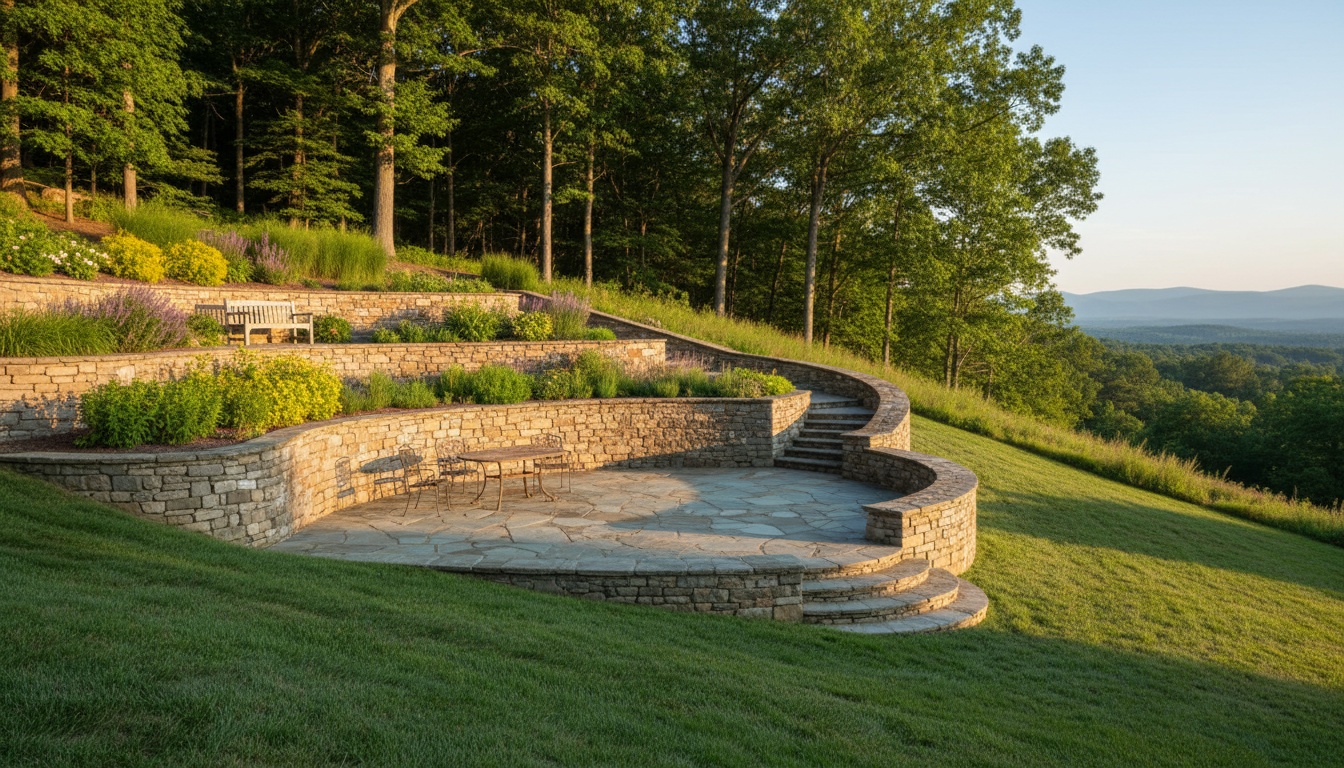
When you need to manage more than 3-4 feet of grade change, you face a fundamental design choice: one tall wall or multiple shorter walls with level planting terraces between them.
Single Wall
A single wall handles the entire grade change in one structure. The advantages are a smaller footprint (the wall takes up less horizontal space than a terraced system) and a simpler construction process. The disadvantages are significant: walls over 4 feet tall require engineered footings, geogrid soil reinforcement, and potentially a structural engineer's stamp. They also create a stark, imposing vertical face that can overwhelm a residential landscape.
Terraced Walls
Two or three shorter walls (each 2-3 feet tall) with 4-6 feet of level ground between them. Terraced walls are structurally more forgiving because each wall retains less soil. They create planting opportunities on each terrace level, breaking the grade change into a series of garden beds rather than a cliff face. The terraces can accommodate groundcovers, perennials, small shrubs, or even functional space for a narrow path or bench.
In most residential situations in Charlottesville, we recommend terracing over single walls when the grade change exceeds 4 feet. The result is more attractive, provides better drainage, creates more planting area, and usually costs less than a single engineered wall of the same total height.
Integrating Seat Walls
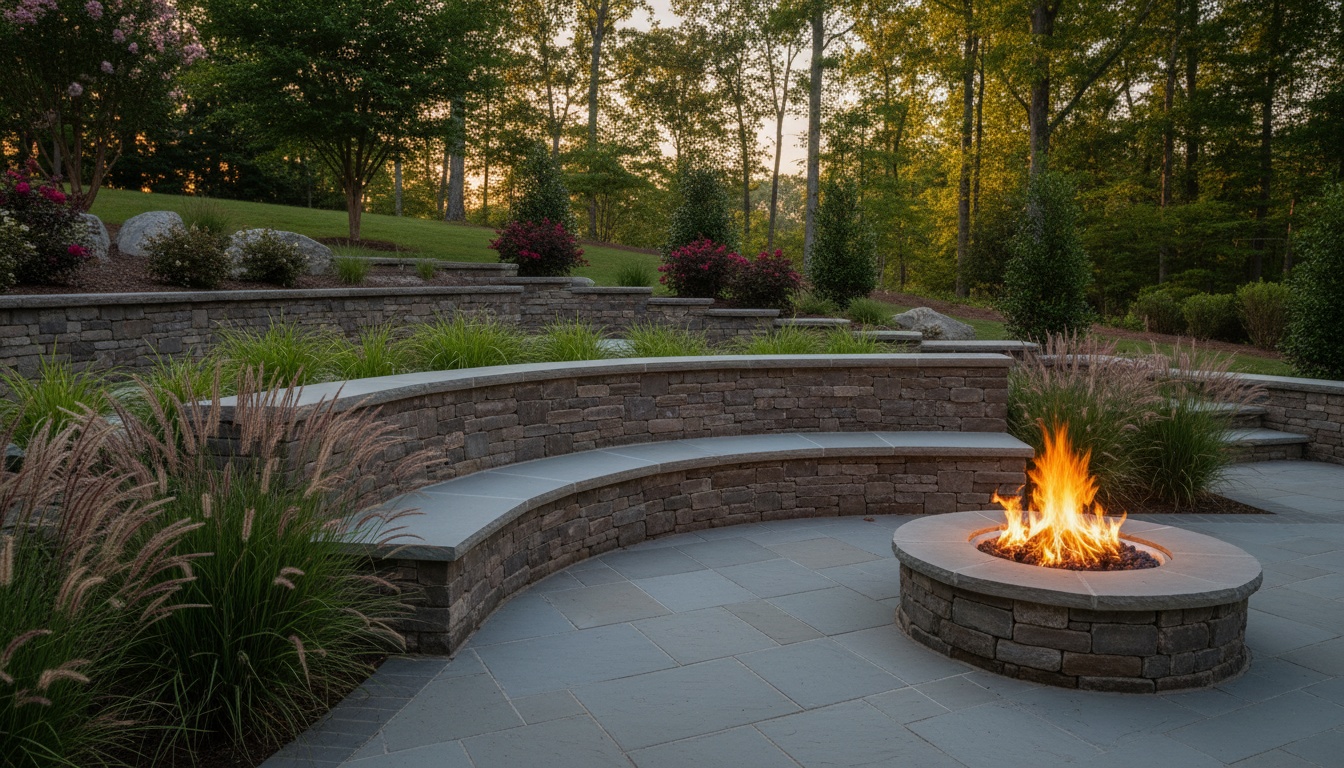
One of the smartest design moves for any retaining wall project is transitioning the wall into a seat wall where it meets a patio, walkway, or gathering area. A seat wall is simply a retaining wall at seating height (16-18 inches) capped with a flat stone (typically 2-inch bluestone or granite) wide enough and smooth enough to sit on comfortably.
Design Considerations
- Height: 16-18 inches from the finished patio surface to the top of the cap. This matches standard chair seat height and is comfortable for most adults.
- Cap width: At least 16 inches for comfortable seating. 18-20 inches allows for cushions.
- Cap material: Thermal-finished bluestone or honed granite provides the smoothest, most comfortable seating surface. Natural cleft stone works but can be uneven. Always use a frost-resistant stone for the cap.
- Cap overhang: A 1-inch overhang beyond the wall face creates a shadow line that adds visual depth and protects the wall face from rain dripping down the cap.
Seat walls are one of the highest-value elements we build. They provide permanent, maintenance-free seating for 8-15 people (depending on wall length), eliminate the need for that many chairs, and serve a structural purpose simultaneously. Around fire pits, along patio edges, and flanking outdoor kitchens, seat walls are indispensable.
Drainage and Engineering
Drainage is the single most important factor in retaining wall longevity. A retaining wall is holding back not just soil but the water that saturates that soil. In Central Virginia, where clay soils hold water like a sponge and annual rainfall approaches 45 inches, a wall without proper drainage is a wall with a countdown clock.
Essential Drainage Components
- Gravel backfill: The space behind the wall (12-18 inches wide) should be filled with clean, crushed gravel (typically #57 stone) rather than the native clay soil. Gravel allows water to drain freely down to the base of the wall instead of building hydrostatic pressure against the wall face.
- Perforated drain pipe: A 4-inch perforated PVC pipe wrapped in filter fabric sits at the base of the gravel backfill, collecting water and directing it to a daylight outlet at the end of the wall. This is the critical piece that prevents water from pooling behind the wall.
- Filter fabric: A layer of geotextile fabric between the gravel backfill and the native soil prevents fine clay particles from migrating into the gravel and clogging the drainage system over time.
- Weep holes: In mortared walls, weep holes (small openings at the base of the wall, spaced every 4-6 feet) allow water to pass through the wall face rather than building pressure behind it.
Structural Engineering
Walls over 4 feet tall (measured from the bottom of the footing to the top of the wall) should be designed by a structural engineer or built using engineered specifications from the stone manufacturer. In Albemarle County, walls over 4 feet require a building permit. The engineering typically involves:
- Concrete footing: A reinforced concrete footing below frost depth (18-24 inches in Central Virginia) provides a stable base that does not shift with freeze-thaw cycles.
- Geogrid reinforcement: Layers of high-strength geogrid fabric are laid horizontally into the retained soil at regular intervals, mechanically tying the soil mass to the wall and distributing the load over a wider area.
- Batter: The wall face is tilted back toward the slope (typically 1 inch of setback per foot of height). This lean counteracts the outward force of the retained soil.
Plants for Retaining Wall Beds
The planting beds above, below, and between retaining walls are opportunities to soften the stone, add seasonal color, and control erosion. Plant selection depends on the wall's exposure and the moisture conditions at each level.
Top of Wall (Behind/Above)
Plants at the top of a retaining wall help stabilize the soil above and soften the upper edge. Use deep-rooted species that hold soil: ornamental grasses like little bluestem (Schizachyrium scoparium), daylilies, catmint, and creeping juniper. Avoid large shrubs or trees directly above the wall -- their root systems can destabilize the structure.
Wall Face and Crevices
Dry-stacked walls with open joints offer planting pockets for creeping plants that cascade down the face. Creeping phlox (Phlox subulata), sedum, creeping thyme, and wall germander (Teucrium chamaedrys) all thrive in the sharp drainage of stone crevices. These plants add color to the wall face and help knit the structure into the surrounding landscape.
Base of Wall
The base of a retaining wall is often a moister microclimate because water drains down to this point. Shade-tolerant, moisture-tolerant species work well here: hostas, heuchera, native ferns, and astilbe. In sunnier locations, Virginia sweetspire, liriope, and switchgrass handle the extra moisture.
Terrace Beds (Between Walls)
The level ground between terraced walls is prime planting space. These beds receive good drainage (water moves through the gravel backfill above) and can support a wide range of perennials, shrubs, and ornamental grasses. Use these beds for high-impact seasonal color: hydrangeas, coneflowers, ornamental grasses, and dwarf shrubs create a layered garden that softens the retaining wall system into something that looks more like a hillside garden than an engineering project.
Cost Considerations
Retaining wall costs in Central Virginia vary based on wall height, stone type, site access, drainage requirements, and whether engineering is required. Here are typical ranges per square foot of wall face, including materials, labor, drainage, and base preparation:
- Dry-stacked fieldstone (under 3 feet): $35-$55/sq ft
- Dry-stacked fieldstone (3-4 feet, with drainage): $45-$65/sq ft
- Mortared bluestone or ledgestone (under 4 feet): $50-$75/sq ft
- Engineered wall over 4 feet (any stone type): $65-$100/sq ft
- Boulder wall: $25-$50/sq ft
- Terraced system (two to three walls with planting beds): $40-$70/sq ft of total wall face
To put that in context: a 30-foot-long, 3-foot-tall fieldstone retaining wall (90 square feet of wall face) typically costs $3,500-$5,500 installed. A terraced system with two 30-foot walls at 2.5 feet each (150 square feet total) with planting beds between them runs $6,000-$10,500.
Factors That Increase Cost
- Site access: If stone and equipment cannot reach the wall location by truck, material must be moved by machine or by hand. Hillside locations with no vehicle access can add 20-30% to the project cost.
- Soil conditions: Heavy clay that requires over-excavation, or rocky ground that requires breaking, adds labor and disposal costs.
- Engineering requirements: Walls over 4 feet requiring a structural engineer's design and stamped drawings add $2,000-$5,000 to the project for the engineering alone.
- Curves: Curved walls require more stone cutting and more skilled labor than straight walls. Budget 15-20% more for curved designs.
- Integrated features: Steps, seat walls, lighting, and planting pockets built into the wall add cost but dramatically increase the wall's functionality and visual impact.
Getting Started
Every retaining wall project starts with understanding the slope. How much grade needs to be managed? What is the soil composition? Where does water flow during a heavy rain? What is the wall's purpose -- structural, aesthetic, or both? These questions determine the wall's height, type, drainage system, and stone selection.
Our hardscaping team begins every retaining wall project with a site evaluation that includes grade measurements, soil assessment, drainage analysis, and a discussion of your goals for the space. From there, we develop a design with detailed specifications, material quantities, and fixed pricing so you know exactly what to expect before any stone is delivered.
If you are considering a retaining wall as part of a larger landscape project -- a patio, outdoor living area, or garden renovation -- we recommend designing everything together. A retaining wall that is integrated into a cohesive landscape plan looks intentional and costs less than adding it as an afterthought.
Contact Snow's to schedule a site evaluation for your retaining wall project. We build year-round in Charlottesville, Albemarle, Greene, Fluvanna, and Nelson counties, and most retaining wall projects are completed in one to three weeks.